
Modern Imaging in Rheumatology: When X-ray, Ultrasound, MRI, PET-CT and DECT Actually Help
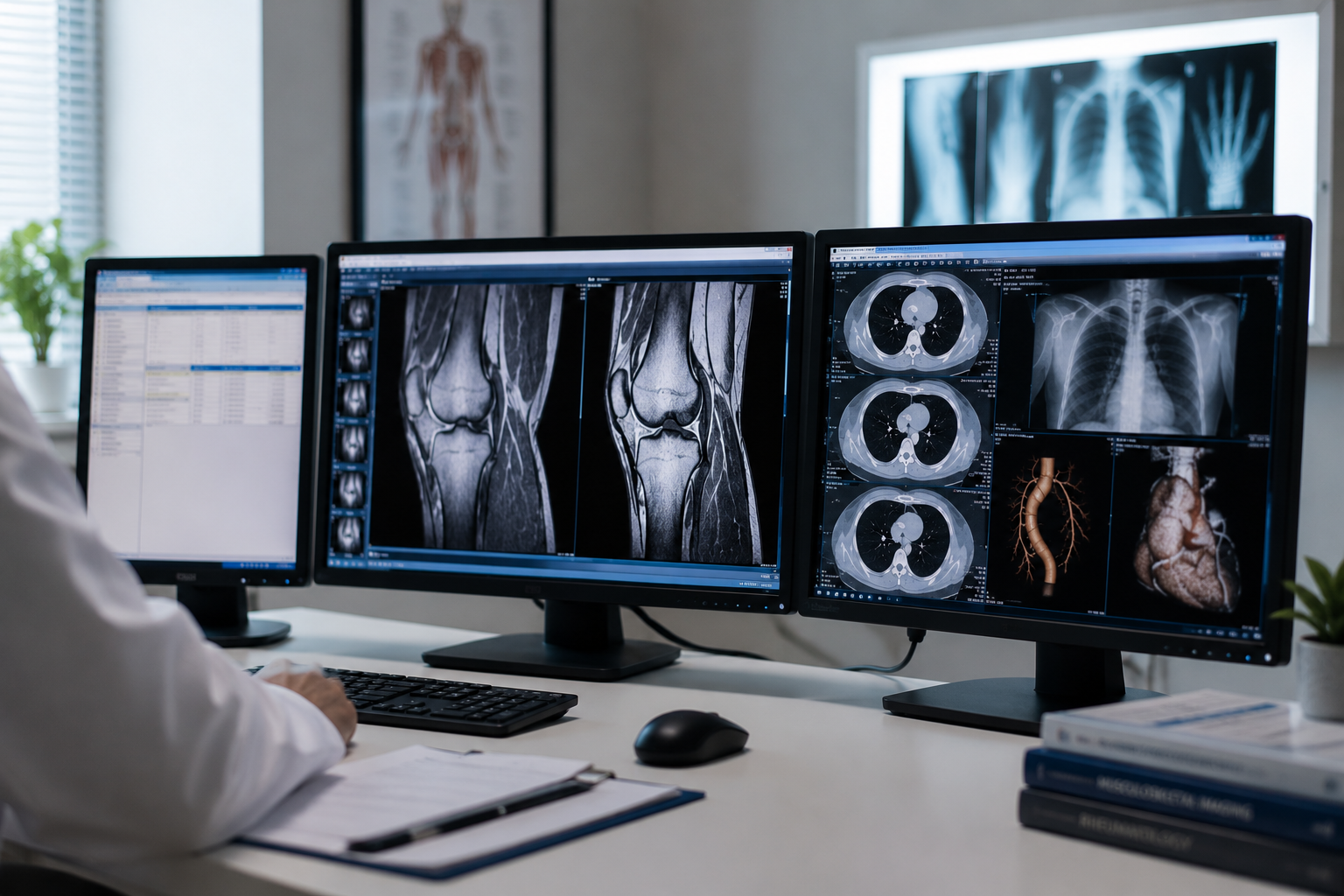
Modern imaging has become increasingly important in rheumatology, but it is still only one part of the picture. Patients are often told they may need an X-ray, ultrasound, MRI or another scan and understandably wonder which one matters most. The answer is that the “best” scan depends on the clinical question being asked.
In rheumatology, imaging is not an end in itself. It is a tool to support diagnosis, assess inflammation or structural damage, guide treatment decisions, and sometimes monitor disease over time. But it is not a substitute for a good history, careful examination, pattern recognition, blood tests, and clinical reasoning. Some scans are very helpful in the right setting. Others are much less useful than patients expect. And in some rheumatic diseases, imaging is not the main thing that establishes the diagnosis at all.
That is one of the most important principles in modern rheumatology: expert clinical assessment comes first, and imaging helps answer specific questions that arise from it.
Why imaging matters in inflammatory disease
Inflammatory rheumatic disease is not always visible in the same way, or at the same stage, on every imaging modality. Some tests are better at showing established structural damage. Others are better at identifying active inflammation early, before permanent change is visible. Some are especially helpful in one disease and of only limited value in another.
This is why the question in clinic is rarely “which scan is best?” It is much more often: what are we trying to find out?
Why X-rays still matter — and where they fall short
X-rays are sometimes seen as old-fashioned compared with MRI or ultrasound, but they still have a useful role. They are particularly helpful for showing structural change: erosions, joint-space narrowing, established sacroiliac change, degenerative change, calcification, fractures, and other bony abnormalities.
That means X-rays can be useful in:
established inflammatory arthritis
osteoarthritis
suspected crystal disease with calcification
suspected fracture or bony abnormality
follow-up of structural damage over time
X-rays can also be useful because they provide a baseline. Even when they are not especially sensitive for early inflammation, they can still offer a useful starting point for future comparison. In the right clinical setting, that can matter later if symptoms evolve, structural change develops, or there is a need to judge whether damage is stable or progressing.
The limitation is that X-rays are relatively poor at showing early inflammation. A patient can have convincing inflammatory symptoms with a normal X-ray. This is especially relevant in early axial spondyloarthritis, where inflammatory change may be present before structural damage becomes visible. So a normal X-ray does not always mean “nothing inflammatory is going on”.
What ultrasound adds
Ultrasound is one of the most useful imaging tools in modern rheumatology when used well. It can show:
synovitis
joint effusions
tenosynovitis
bursitis
enthesitis
erosions in some joints
and crystal deposition in the right setting
It is dynamic, relatively accessible, and can be used alongside the examination rather than in isolation. That makes it especially helpful where the question is: is there active inflammation here now?
Ultrasound is also very useful in selected procedures such as aspiration or injection, particularly when precision matters.
Its limitations are important too. It is operator-dependent, some structures are difficult to assess well, and a normal ultrasound does not automatically end the diagnostic conversation if the clinical pattern remains persuasive.
When MRI is especially helpful
MRI is particularly useful when the aim is to detect active inflammatory change early, especially where plain X-rays are unhelpful or normal. In rheumatology, MRI is especially important in:
suspected axial spondyloarthritis, where it can identify active sacroiliac inflammation or bone marrow oedema before structural damage appears on X-ray
selected cases of rheumatoid arthritis, where it may show synovitis, tenosynovitis, osteitis and erosive change
selected soft-tissue or deeper anatomical problems that ultrasound cannot assess adequately
MRI is powerful, but it is not a general-purpose answer to every inflammatory symptom. It is most helpful when there is a focused question and a realistic expectation that the result will alter diagnosis or management.
Where PET-CT fits
PET-CT has a much more selective role in rheumatology. It is not a routine test for ordinary joint pain or day-to-day inflammatory arthritis assessment. Its main established role is in certain cases of large vessel vasculitis, especially where clinicians are trying to assess inflammation in major arteries.
But PET-CT can also be helpful in some broader inflammatory scenarios, including selected cases of sarcoidosis, IgG4-related disease, or when there is concern about an alternative explanation for systemic inflammatory symptoms such as deep infection or occult malignancy. In those settings, it is not being used as a routine rheumatology scan, but as part of a wider diagnostic strategy.
So PET-CT is best thought of as a specialist tool for specialist questions, not a general inflammatory-disease scan.
Where DECT fits
DECT, or dual-energy CT, is most useful in gout. It can help identify and characterise urate crystal deposition, which is why it has become increasingly useful in diagnostic uncertainty around crystal arthritis.
This can be particularly helpful when:
the diagnosis is in doubt
aspiration has not been possible
the clinical picture overlaps with osteoarthritis, pseudogout or another cause of recurrent joint symptoms
DECT is therefore not a routine rheumatology scan in general, but it can be very helpful in the right gout-related question.
Where CT and MR angiography fit
It is also worth distinguishing angiographic imaging from the other imaging modalities discussed above. In selected cases of arterial inflammation, CT angiography or MR angiography may help assess vessel wall change, stenosis, occlusion, aneurysm or other arterial abnormalities. These are not routine scans for general inflammatory arthritis, but they can be important in suspected large vessel vasculitis or other selected vascular inflammatory syndromes.
In practice, these are specialist tools used when the clinical picture suggests arterial involvement and the imaging result is likely to affect diagnosis or management.
Sometimes imaging helps look beyond classic rheumatology diagnoses
Another important role of modern imaging is that it can occasionally help identify conditions that sit around the edges of rheumatology, mimic inflammatory disease, or complicate it.
In selected cases, imaging may be used not just to confirm inflammatory arthritis or vasculitis, but to look for:
sarcoidosis
IgG4-related disease
deep-seated infection
paraneoplastic disease or occult malignancy
and other systemic inflammatory or infiltrative conditions that can present with rheumatic symptoms
This is particularly relevant when the clinical picture is atypical, more systemic than expected, or does not fit neatly into a single rheumatological diagnosis.
This is one reason broader medical expertise matters. In more complex cases, the question is not only which rheumatology diagnosis fits best, but whether the presentation could reflect a systemic inflammatory mimic, an organ-specific complication, or a non-rheumatological driver of rheumatic symptoms. Being dual-trained in rheumatology and general internal medicine, and working in a tertiary-centre environment, can be especially helpful in that sort of setting because it encourages a broader differential and more thoughtful selection of investigations.
What about CT imaging for lung involvement in connective tissue disease?
Modern rheumatology is not only about joints. Some connective tissue diseases can involve internal organs, and imaging may then be important for reasons that have little to do with joint inflammation itself.
A good example is interstitial lung disease in connective tissue disease. In conditions such as systemic sclerosis, inflammatory myositis, rheumatoid arthritis and some other connective tissue diseases, high-resolution CT can be very important when there is concern about inflammatory or fibrotic lung involvement. In these situations, imaging is not being used to diagnose the connective tissue disease itself, but to define an important complication or organ manifestation that affects prognosis and management.
This is an important reminder that in rheumatology, imaging sometimes supports diagnosis directly, but sometimes it supports staging, complication assessment, or treatment planning rather than establishing the core diagnosis.
Some rheumatic diseases are not diagnosed mainly through imaging
This is a point patients often find helpful.
Not every rheumatic disease has a “good scan” that confirms it. Some conditions are diagnosed mainly through the clinical pattern, the blood tests, and the broader systemic picture, with imaging playing only a limited or indirect role.
That is particularly relevant in diseases such as:
lupus
Sjögren’s syndrome
some other connective tissue diseases
In these conditions, imaging may be useful for selected complications or organ involvement, but there is often no single scan that “shows the disease” in the way patients sometimes expect. This is one reason specialist assessment matters so much. If the diagnosis is mainly clinical and immunological, imaging may be normal or only secondarily helpful.
There are times when imaging is not needed to confirm the diagnosis
This is another important principle in rheumatology and musculoskeletal medicine: sometimes imaging is useful, and sometimes it is not actually needed to make the diagnosis at all.
A good example is osteoarthritis. In many patients, especially when the history and examination are typical, osteoarthritis can be diagnosed clinically without imaging. That matters, because patients are often reassured by the idea of “seeing it on a scan”, but in reality the diagnosis may already be clear from the pattern of symptoms and examination alone.
This is also where more imaging is not always more helpful. MRI, CT or other detailed imaging may show the extent of degenerative or structural change in great detail, but that does not necessarily mean the findings explain the symptoms. In practical terms, that means some people have quite marked degenerative change on imaging with modest symptoms, while others have significant pain with relatively limited structural change visible.
So in osteoarthritis and other clearly mechanical or degenerative problems, more detailed imaging is often only worth pursuing if there is a specific clinical reason to do so. That may include:
uncertainty about whether the diagnosis is correct
concern about an alternative or additional diagnosis
planning a specific intervention or procedure
assessing a complication
or deciding whether surgical opinion is needed
Otherwise, more imaging can sometimes add detail without adding meaningful clarity.
This is another reason expert assessment matters. The aim is not simply to confirm what is already obvious, or to catalogue every structural change visible on a scan. It is to decide whether imaging will genuinely help diagnosis, management or decision-making.
Imaging is only as useful as the quality of its interpretation
Another important point is that the value of imaging depends not only on which scan is chosen, but also on who interprets it. A scan report is not a diagnosis in itself. The significance of an imaging finding depends on the clinical context, the quality of the scan, and the experience of the person reviewing it.
In rheumatology, subtle inflammatory changes can be missed, overcalled, or described in a way that is technically accurate but not especially helpful unless they are interpreted alongside the patient’s symptoms and examination. That is one reason why the same scan may be much more useful when reviewed by someone with expertise in inflammatory musculoskeletal disease.
This is especially relevant in areas such as:
early sacroiliac MRI change
subtle synovitis or tenosynovitis on ultrasound
crystal deposition
vasculitic imaging
and connective tissue disease-related lung or vascular involvement
So in practice, good imaging is not just about access to modern scans. It is also about asking the right question, choosing the right test, and making sure the result is interpreted by someone with the right expertise.
More testing is not always better
One of the real challenges in modern medicine, including private practice, is that blood tests and scans can sometimes be organised without a clear enough clinical question behind them. That does not usually come from bad intentions. It often comes from understandable anxiety, pressure to be thorough, or the hope that more information will automatically lead to more clarity.
But in practice, that is not always what happens.
Investigations that are not well targeted can produce incidental findings — abnormalities that may be unrelated to the patient’s symptoms, of uncertain significance, or ultimately harmless. Once found, those results can generate more scans, more blood tests, more referrals and more anxiety, without necessarily bringing the patient any closer to a meaningful diagnosis.
This applies to blood tests as well as imaging. A mildly abnormal autoimmune test, a non-specific inflammatory marker, or a scan finding that does not match the clinical story can all create unnecessary worry if they are not interpreted carefully and in context.
That is why expert assessment matters so much. The goal is not to order as many investigations as possible. It is to decide which investigations are actually likely to answer an important clinical question, and which are more likely to muddy the waters.
In good rheumatology practice, investigations should be:
guided by the history and examination
chosen because they are likely to change diagnosis or management
interpreted in the context of the wider clinical picture
and discussed with the patient so there is shared understanding about why they are being done and what the results may or may not mean
That sort of joint decision-making is important. It helps patients understand not only what is being investigated, but also why some tests may be more useful than others — and why sometimes the most sensible decision is not to investigate widely, but to investigate thoughtfully.
A private consultation can be particularly helpful here. For some patients, the real value lies not in doing more blood tests or more scans, but in having an expert assessment first, followed by a sensible and proportionate investigation plan that is tailored to the actual clinical question.
Why the clinical assessment still matters most
The most important principle in all of this is that imaging does not replace an expert clinical assessment. A scan should support diagnosis, management and decision-making, not become a substitute for thinking.
A patient with a strongly inflammatory history but a non-diagnostic early scan may still need follow-up, repeat assessment, or a different imaging modality. Equally, an abnormal scan in the wrong clinical context may mislead rather than clarify.
This is particularly relevant in private practice, where patients often arrive after having already had one or more scans. The key question is rarely “can we do more imaging?” It is more often:
what does the existing imaging actually show?
what does it not show?
and what is the next most useful step?
When modern imaging is especially helpful in practice
In real rheumatology practice, modern imaging is often most helpful when:
symptoms are suggestive of inflammation but X-rays are normal
there is uncertainty about whether swelling or pain reflects active synovitis
inflammatory back pain raises concern about early axial spondyloarthritis
there is concern about giant cell arteritis or large vessel vasculitis
recurrent joint attacks raise doubt about gout or crystal arthritis
there is concern about connective tissue disease-associated lung involvement
a procedure such as injection or aspiration would benefit from image guidance
diagnosis is unclear and imaging is likely to change management, not just add another report
That is also why specialist review can be valuable. It helps ensure that the imaging being requested is the right imaging for the right question, rather than simply more imaging.
The bottom line
Modern imaging has transformed rheumatology, but it has not replaced clinical judgement. X-ray, ultrasound, MRI, PET-CT, DECT, CT and angiographic imaging each have their place, and each can be extremely useful in the right setting. But none of them is a substitute for careful history-taking, examination, pattern recognition and thoughtful decision-making.
The goal is not simply to obtain more imaging, but to obtain the right imaging, at the right time, for the right question, with the right interpretation.
That is what makes modern imaging genuinely helpful in the assessment of inflammatory disease.
Please note, these posts are for general information only and do not constitute medical advice. Dr Singh would encourage you to speak to your healthcare professional to be assessed and managed for your specific symptoms.