
Colchicine: An Old Drug Still Critical in the Modern Management of Gout
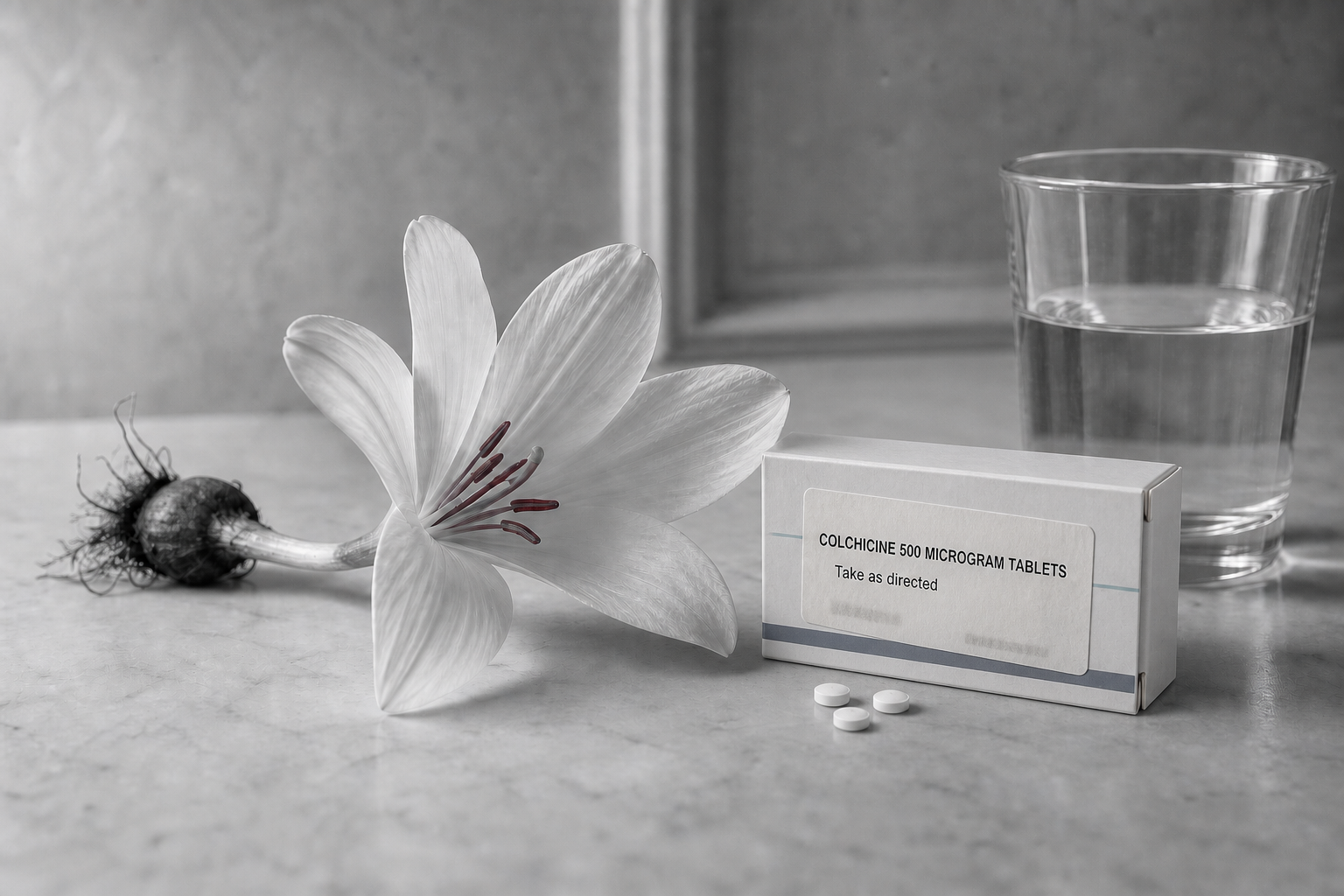
Few medicines connect ancient and modern practice as directly as colchicine.
Colchicine is derived from Colchicum autumnale, commonly known as the autumn crocus or meadow saffron. Preparations made from this plant were described in ancient medicine for painful swelling and joint complaints. Their use is often traced back to the Egyptian Ebers Papyrus from around 1500 BC, while plant preparations containing colchicine were subsequently used for gout in the Greek and Byzantine medical traditions. The Byzantine physician Alexander of Tralles described its use for gout in the sixth century.
Ancient physicians did not know about urate crystals, neutrophils or inflammatory pathways. They had nevertheless observed that preparations from the autumn crocus could produce a striking improvement in the intensely painful attacks we now recognise as gout.
The plant was also poisonous, and the difference between a helpful quantity and a dangerous one was poorly controlled. It was not until the nineteenth century that its active ingredient was isolated and purified as colchicine.
Today, colchicine is manufactured as a precisely measured medicine rather than administered as a plant preparation. Its mechanism is much better understood, its dosing is safer and its role is supported by modern clinical evidence. Yet the fundamental observation made centuries ago remains valid: colchicine can be remarkably effective at suppressing the inflammation caused by gout.
Its long history can create two opposite misconceptions. Some patients assume that an old medicine must now be outdated. Others regard it as a simple traditional remedy that can be taken whenever joint pain occurs.
Neither view is correct.
Colchicine remains highly relevant, but it must be used for the right reason, at an appropriate dose and with careful attention to kidney function, other medication and potential interactions. It does not lower uric acid or cure gout. It also has a relatively narrow safety margin, meaning that taking more than prescribed can be dangerous.
Understanding what colchicine can—and cannot—do is therefore an important part of managing gout properly.
What is colchicine?
Colchicine is an anti-inflammatory medicine, but it is not a conventional non-steroidal anti-inflammatory drug such as ibuprofen or naproxen. It is also not a steroid or a painkiller in the usual sense.
During a gout flare, microscopic monosodium urate crystals trigger a powerful inflammatory response inside and around the affected joint. Immune cells, particularly neutrophils, move into the area and contribute to the rapid onset of pain, swelling, heat and tenderness.
Colchicine interferes with this inflammatory response. It disrupts microtubules, which form part of the internal structure and transport system of cells. This reduces the ability of neutrophils to move towards and react to urate crystals and helps interrupt the inflammatory cascade responsible for a gout attack.
This is why colchicine can settle inflammation during a flare even though it does not directly remove the crystals or reduce the blood uric-acid level.
How is colchicine used in gout?
Colchicine has two principal roles in gout. It can be used to treat an acute attack, and it can be prescribed temporarily to reduce the risk of flares when urate-lowering treatment is started or adjusted.
These uses are related but distinct.
Treating an acute gout flare
An acute gout flare often develops rapidly, sometimes over only a few hours. The affected joint may become intensely painful, swollen, hot and extremely sensitive to touch.
Colchicine is one of the established treatments for a flare. Other options include a non-steroidal anti-inflammatory drug or a short course of corticosteroid. No single treatment is best for everyone.
The choice depends on the patient’s kidney and liver function, gastrointestinal and cardiovascular history, diabetes, current medication, previous response to treatment and risk of drug interactions.
Colchicine tends to be most useful when taken early in the attack. It may be less effective once severe inflammation has been established for several days, although individual circumstances vary.
Modern treatment uses lower doses than many historical regimens. Older high-dose approaches caused considerable diarrhoea and toxicity without providing sufficient additional benefit. Patients should follow their prescribed instructions rather than continuing to take tablets until either the pain or their digestive system forces them to stop.
The appropriate regimen is not identical for everyone. It may need adjustment—or colchicine may need to be avoided altogether—when kidney or liver function is impaired or an interacting medicine is being taken.
Preventing flares when uric-acid treatment begins
Starting or increasing urate-lowering treatment, such as allopurinol or febuxostat, can temporarily provoke gout attacks.
This understandably confuses patients. They may conclude that the new medicine is making their gout worse or that they are allergic to it. Some then stop the urate-lowering treatment just as it is beginning to address the underlying cause.
The explanation is different.
As the blood uric-acid level falls, existing urate deposits within the joints begin to change and dissolve. During this transition, crystals can temporarily become more likely to trigger inflammation. This does not mean the treatment is failing.
Low-dose colchicine may therefore be prescribed while urate-lowering treatment is introduced and gradually adjusted towards the target urate level. Its role is to reduce the risk of attacks while the crystal burden is being brought under control.
Colchicine provides temporary protection. The urate-lowering medicine performs the long-term disease-modifying work.
You can read more about this distinction in Allopurinol and Febuxostat for Gout: When They Are Used and What Patients Should Know.
Colchicine does not lower uric acid
This is its most important limitation.
Colchicine controls the inflammatory reaction caused by urate crystals. It does not reduce uric-acid production, increase the removal of uric acid or clear the body’s crystal burden by itself.
A patient may become very skilled at suppressing individual attacks with colchicine while the underlying gout continues to progress.
Repeated attacks are not simply isolated painful events. They usually indicate that urate crystals remain within the joints and tissues. Over time, uncontrolled gout can cause increasingly frequent attacks, tophi, persistent joint inflammation and permanent structural damage.
Recurrent gout therefore usually deserves a long-term plan rather than repeated courses of flare treatment alone.
This is explored further in Gout: More Than Just a Diet Problem and Gout and Cardiovascular Risk: Why Recurrent Gout Should Be Taken Seriously.
Why does colchicine cause gastrointestinal symptoms?
Diarrhoea, abdominal discomfort, nausea and vomiting are among the best-known adverse effects of colchicine.
These symptoms are partly related to the way colchicine affects rapidly renewing cells within the lining of the intestine. It can alter intestinal secretion, movement and absorption. The result may be cramping, loose stools and abdominal discomfort.
There is also evidence that colchicine can reduce lactase activity in the intestinal lining and cause secondary lactose malabsorption in some patients. Lactase is the enzyme needed to digest lactose, the natural sugar found in milk and dairy products.
If lactase activity falls, lactose passes into the large bowel without being fully digested. This can produce bloating, wind, abdominal pain and diarrhoea. In patients who already have some degree of lactose intolerance, colchicine may aggravate these symptoms.
A small clinical study in people taking long-term colchicine for familial Mediterranean fever found increased lactose malabsorption and lactose-related symptoms. A lactose-reduced diet produced partial improvement in some participants. This suggests that acquired lactose malabsorption may explain part—but not all—of the gastrointestinal intolerance associated with colchicine.
It is more accurate to describe this as a potentially reversible, drug-related reduction in lactose absorption rather than colchicine permanently causing lactose intolerance in every patient.
There is a separate consideration: some colchicine tablet formulations contain a small amount of lactose as an inactive ingredient. This is different from, and generally less important than, the effect colchicine may have on intestinal lactase activity. Nevertheless, the formulation can matter for people with certain rare hereditary disorders of galactose or lactose metabolism.
Gastrointestinal symptoms should never be regarded as proof that colchicine is working. They may indicate that the medicine is not being tolerated and, in some circumstances, can be an early warning of toxicity.
Patients should not take further doses beyond the prescribed regimen. Significant vomiting, diarrhoea or abdominal pain after colchicine should prompt medical advice rather than further self-treatment.
Why medication interactions matter
Colchicine is handled by the body through pathways involving the CYP3A4 enzyme and the P-glycoprotein transport system. Some medicines inhibit these pathways and can cause colchicine concentrations to rise substantially.
Particularly important interactions can occur with clarithromycin and erythromycin, some antifungal and antiviral medicines, ciclosporin, and heart medicines such as verapamil and diltiazem. Some statins and other medicines that affect muscle, kidney, liver or bone-marrow function may also increase the risk of adverse effects.
This does not mean that every combination is automatically prohibited. It means that the complete medication list must be checked before colchicine is prescribed or continued.
A particularly important situation occurs when someone already taking colchicine develops an infection and is prescribed an antibiotic. The prescriber and pharmacist must know that colchicine is being taken before the antibiotic is started.
Patients should also mention non-prescription medicines, supplements and grapefruit consumption because these can affect how colchicine is processed.
Kidney and liver function
Colchicine is partly cleared through the kidneys and processed by the liver. Reduced kidney or liver function can increase exposure to the medicine and raise the risk of toxicity.
Extra caution is required in chronic kidney disease, significant liver disease, older or frail patients and people taking interacting medication. This may require a lower dose, a longer interval between courses or selection of a different treatment.
Severe kidney impairment is particularly important because colchicine is not effectively removed simply by dialysis.
This is one reason repeated prescriptions should not become an automatic response to every episode of joint pain. The diagnosis, current medication and organ function should be reconsidered.
Serious colchicine toxicity
Serious toxicity is uncommon when colchicine is prescribed appropriately and taken correctly, but overdose can be life-threatening.
Early toxicity often affects the gastrointestinal system, causing marked vomiting, diarrhoea and abdominal pain. More severe poisoning can subsequently affect the muscles, nerves, blood cells, liver, kidneys, lungs and cardiovascular system.
Unexplained weakness, muscle pain, numbness, unusual bruising, bleeding, fever, mouth ulcers or a sore throat also require attention, particularly during prolonged treatment or when interacting medicines are being used.
There is no simple home treatment for colchicine overdose. Anyone who has taken more than prescribed should seek urgent medical advice even if they initially feel well.
Colchicine and muscle problems
Rarely, colchicine can cause muscle or combined nerve-and-muscle toxicity. This is more likely when the medicine accumulates because of kidney impairment or an interaction with another drug.
The risk may be greater when colchicine is combined with medicines that can also affect muscle, including certain statins.
New unexplained muscle pain, genuine weakness or dark urine deserves prompt assessment. This is different from the local pain around an acutely inflamed gouty joint.
Does long-term colchicine require monitoring?
The necessary monitoring depends on the dose, duration, reason for treatment and the individual patient’s risk factors.
During prolonged or repeated treatment, it may be appropriate to monitor kidney and liver function, blood counts, medication interactions and new muscle symptoms. Long-term use has also been associated with reduced vitamin B12 absorption in some patients.
Monitoring does not replace careful prescribing. The first step is always to confirm that colchicine remains necessary and that the dose is appropriate.
Is colchicine used outside gout?
Colchicine has important uses outside gout, although these require condition-specific medical guidance.
It is a central treatment for familial Mediterranean fever, an inherited autoinflammatory disorder that causes recurrent episodes of fever and inflammation. Regular colchicine can reduce attacks and help prevent AA amyloidosis, a serious complication that may damage the kidneys and other organs.
Colchicine is also used in acute and recurrent pericarditis, usually alongside other treatment. In appropriately selected patients, it can reduce the risk of recurrence.
It may occasionally be considered for other autoinflammatory conditions or recurrent serositis under specialist care. This does not make colchicine a general treatment for undiagnosed “inflammation,” chest pain, abdominal pain or joint pain.
What if presumed gout does not respond to colchicine?
Failure to improve does not automatically mean that a larger dose is needed.
Colchicine may have been started too late, the attack may be particularly severe, or the dose may be limited by other medical risks. It is also possible that the diagnosis is not gout.
Pseudogout, another inflammatory arthritis, mechanical joint disease and infection can all be mistaken for gout. A hot, swollen joint can occasionally represent septic arthritis, which requires urgent assessment—particularly when accompanied by fever, systemic illness, immunosuppression, recent surgery or a prosthetic joint.
Joint aspiration and crystal analysis may be needed when the diagnosis remains uncertain.
A better long-term approach to recurrent gout
Good gout care involves more than supplying tablets for the next attack.
A proper assessment should establish whether the diagnosis is secure, how frequently attacks occur, whether tophi or joint damage are present and whether urate-lowering treatment is needed. Kidney function, cardiovascular health, metabolic risk, alcohol, weight and medicines such as diuretics should be considered as part of the same assessment.
If urate-lowering treatment is started, it should usually be adjusted against a defined serum-urate target rather than prescribed at an arbitrary dose and left unchanged. Colchicine may support this process by preventing temporary flares, but it cannot replace it.
Diet can influence gout, but gout is not simply the result of dietary excess. Genetics, kidney handling of urate, medication and associated medical conditions are often more important than patients have been led to believe.
Read Gout: Why the Right Diagnosis Can Change Everything for more about establishing the diagnosis and developing an appropriate plan.
When might specialist assessment help?
Specialist assessment may be helpful when the diagnosis remains uncertain, attacks are frequent, several joints are involved or standard flare treatments are contraindicated or ineffective.
It can also be valuable when kidney disease complicates prescribing, urate remains above target, allopurinol or febuxostat has not been tolerated, tophi may be present or repeated attacks are being treated without a clear long-term strategy.
The purpose is not simply to prescribe a different medicine. It is to determine whether gout is genuinely the diagnosis, assess the wider medical context and develop a plan that prevents further attacks.
The bottom line
Colchicine remains relevant in modern medicine because it can suppress crystal-driven inflammation and reduce flares while urate-lowering treatment is being established.
But it must be respected.
Colchicine has a defined role, important interactions and a narrow margin between an appropriate dose and toxicity. Gastrointestinal symptoms are common, and secondary lactose malabsorption may contribute to these symptoms in some patients.
Most importantly, colchicine treats the inflammatory consequences of urate crystals. It does not remove the underlying cause of gout.
For someone experiencing recurrent attacks, the most useful question is therefore not simply:
“Can I have more colchicine?”
It is:
“Why am I continuing to have gout attacks, and what long-term plan will stop them?”
Please note, these posts are for general information only and do not constitute medical advice. Dr Singh would encourage you to speak to your healthcare professional to be assessed and managed for your specific symptoms.