
Is It Worth Having a Private Rheumatology Video Consultation?
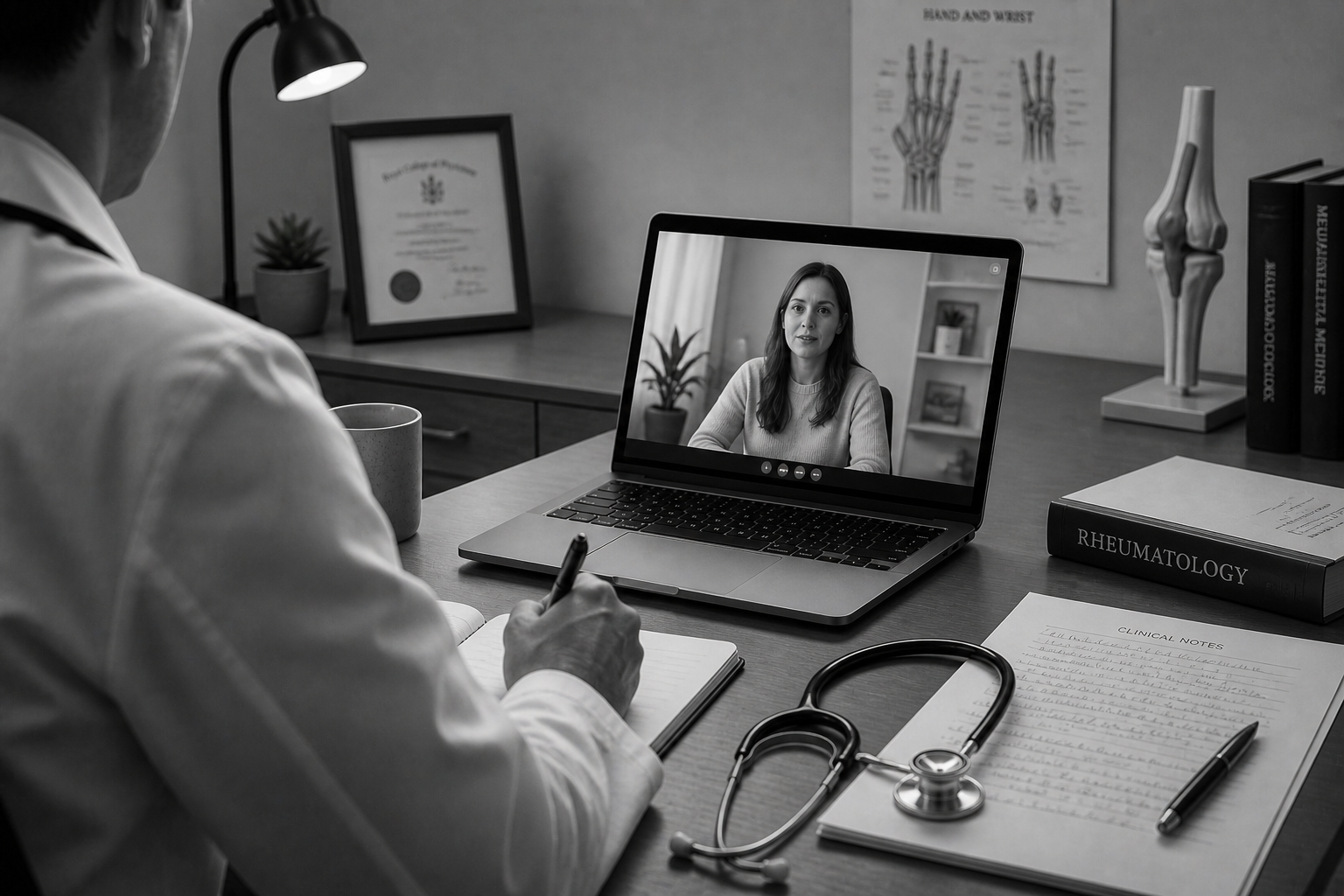
Private video consultations are now a familiar part of medical care, but many patients still wonder whether they are really worthwhile in a specialty like rheumatology. It is a sensible question. Rheumatology often depends on careful history-taking, pattern recognition, examination, blood tests and imaging. So it is reasonable to ask whether a video consultation can do the job properly, or whether it risks becoming an expensive extra step before a face-to-face appointment anyway.
In my view, a private rheumatology video consultation can be very worthwhile in the right circumstances. It is not the right format for every patient or every problem, but it can be an efficient and useful way to assess symptoms, review results, discuss diagnoses, give treatment advice, and decide what should happen next.
The key question is not whether video is always as good as face-to-face. It is whether it is the right format for the particular clinical problem.
Why patients consider a video consultation
There are many reasons why patients choose a video appointment. Some live a long way from the clinic, travel frequently, or want a second opinion without making a special journey. Some have work or family commitments that make it easier to speak from home or the office. Others are in pain, fatigued, or struggling with mobility and would prefer not to travel unless it is clearly necessary.
For some people, speed is also part of the appeal. A video consultation can sometimes be a practical way to get an expert opinion more quickly, particularly when the main need is to review symptoms, interpret blood tests, discuss scan results, or think through the likely diagnosis and next steps. It may also allow an urgent appointment to be arranged outside standard clinic times, or provide a practical option when travel is difficult because of pain, mobility, distance or other commitments.
That is especially relevant in rheumatology, where patients often arrive with a mixture of symptoms, previous test results, uncertainty and understandable anxiety. In those situations, a video consultation may be a very reasonable first step.
What a rheumatology video consultation can do well
Rheumatology is a specialty where the history matters enormously. The pattern of symptoms, how they began, whether there is morning stiffness, swelling, fatigue, rashes, mouth ulcers, Raynaud’s, back pain, fevers, weight loss, or a history of psoriasis or bowel disease can all be highly informative. Much of that can be explored very effectively by video.
A video consultation can also work well for:
discussing abnormal blood tests
reviewing previous letters, scans or diagnoses
talking through the likely causes of symptoms
deciding whether inflammation is truly likely
planning further investigations
reviewing treatment options
offering a second opinion
following up an established diagnosis
In some cases, video is particularly good for the sort of questions patients often bring to private rheumatology: What do these blood tests mean? Do I really have an autoimmune disease? Is this inflammatory arthritis? Should I start treatment? Do I need to be seen in person?
Can a video consultation work for a first appointment?
Yes, often it can.
A first rheumatology appointment is not just about examining joints. It is also about understanding the history properly, reviewing what has happened so far, looking at previous results, and deciding what the most likely explanations are. In many cases, a video consultation can achieve a great deal of that.
Sometimes it may be enough on its own, particularly when the issue is interpretation, review, follow-up, or a second opinion. Sometimes it leads to a plan for further blood tests, imaging, or treatment. And sometimes it helps determine that a face-to-face review would be the better next step.
That still represents value. A useful consultation is not only one that ends with a prescription or a physical examination. It may also be one that clarifies the story, narrows the possibilities, explains what matters and what does not, and makes the next step much clearer.
When face-to-face is usually better
There are, however, situations where an in-person appointment is clearly preferable.
A face-to-face consultation is usually better when:
joints are visibly swollen and need examination
the diagnosis depends heavily on physical findings
aspiration or injection may be needed
there is a complex musculoskeletal problem where detailed examination matters
there is significant diagnostic uncertainty that cannot be resolved remotely
the patient is very unwell and needs a fuller physical assessment
In rheumatology, examination still matters. Looking at joints on screen can sometimes be helpful, but it is not the same as palpating them, assessing warmth, checking range of movement directly, or performing a more detailed musculoskeletal examination.
That is why I think the most honest position is this: video consultations can be excellent in the right setting, but they are not a perfect substitute for face-to-face care in every situation.
When video consultations work especially well
In my experience, video works particularly well for:
second opinions
review of blood tests and scan results
medication reviews
follow-up after investigations
discussion of treatment plans
stable follow-up in established disease
patients travelling from outside London
patients who want to decide first whether a face-to-face consultation is likely to be worthwhile
This is particularly true where the aim is clarity rather than procedure. If the real need is to understand the diagnosis better, review options in detail, or decide what should happen next, a video consultation can often do that very effectively.
What a video consultation cannot do
The limitations are important to acknowledge.
A video consultation cannot provide a hands-on physical examination. It cannot aspirate a joint, perform an injection, or assess certain findings as confidently as an in-person consultation. Some aspects of movement can be demonstrated on camera, but not everything is easy to judge remotely. Swelling may be obvious in some patients and much less clear in others. Tenderness, warmth and subtle physical signs are harder to assess.
So a video consultation should not be presented as though it can do everything. It is better thought of as one tool among several. In some cases it is the ideal first step. In others it is mainly useful for follow-up or interpretation. And in some cases, a face-to-face review is clearly the better format from the outset.
How are video consultations carried out?
Video consultations are usually carried out through the secure Carebit video consultation platform. Where needed, alternatives such as WhatsApp video or Zoom can also be arranged.
In practical terms, it helps to have a quiet place to talk, a stable internet connection, good audio, and a phone, tablet or computer positioned so that the camera and sound work clearly. It is also helpful to upload any relevant clinic letters, blood tests, scan reports and medication lists in advance where possible, so these can be reviewed properly during the consultation.
How to prepare for a video consultation
A video consultation is usually most useful when a few practical things are in place beforehand. It helps to be somewhere quiet and private, with a good Wi-Fi connection, clear audio and enough time to talk without interruption. Good lighting and a device positioned steadily can also make a difference, particularly if you may be asked to show a rash, swollen joint or pattern of movement.
It is also worth gathering together any relevant medical information in advance. That may include previous clinic letters, blood test results, scan reports, medication lists, and details of any treatments you have already tried. If possible, these should be uploaded before the consultation so they can be reviewed properly in context.
Patients often find it useful to think beforehand about the timeline of symptoms as well: when they started, whether they are constant or episodic, what makes them worse or better, whether there is morning stiffness, visible swelling, fatigue, rashes, ulcers, Raynaud’s, back pain, fevers or weight loss, and what the main questions are they want answered.
A video consultation does not need a great deal of preparation, but a small amount of organisation can make it much more efficient and much more valuable.
Video consultations can also be valuable when family members are in different countries. One recent patient review described arranging a consultation from the UK for a relative in Sri Lanka, with the discussion taking place by WhatsApp/Zoom and followed by a coordinated handover to an appropriate local doctor. For some families, that sort of flexibility and continuity can be extremely helpful.
Is a video consultation worth it if I may still need to come in later?
Sometimes yes.
Patients often worry that a video consultation is only worth doing if it completely replaces a face-to-face appointment. I do not think that is the right test. If a video consultation helps clarify the likely diagnosis, review previous results properly, identify what further tests are actually needed, or determine whether a face-to-face examination is genuinely necessary, it may still save time, uncertainty and unnecessary travel.
It can also make any later face-to-face appointment more focused and more useful. Rather than starting from scratch, the in-person visit can then build on a clearer understanding of the history and the clinical questions that remain.
So even if a later face-to-face assessment is needed, the video consultation may still have done an important part of the work.
The bottom line
A private rheumatology video consultation can be very worthwhile, but it is not right for every situation.
It works especially well for history-taking, interpreting test results, discussing diagnoses, reviewing treatment options, follow-up, and second opinions. It is less suitable when the main issue is a detailed physical examination, a procedure, or a problem that clearly needs hands-on assessment.
The real question is not whether video is always as good as face-to-face. It is whether it is the right format for the clinical problem in front of you.
In many cases, it is. And even where it is not the whole answer, it can still be a very useful first step.
Please note, these posts are for general information only and do not constitute medical advice. Dr Singh would encourage you to speak to your healthcare professional to be assessed and managed for your specific symptoms.