
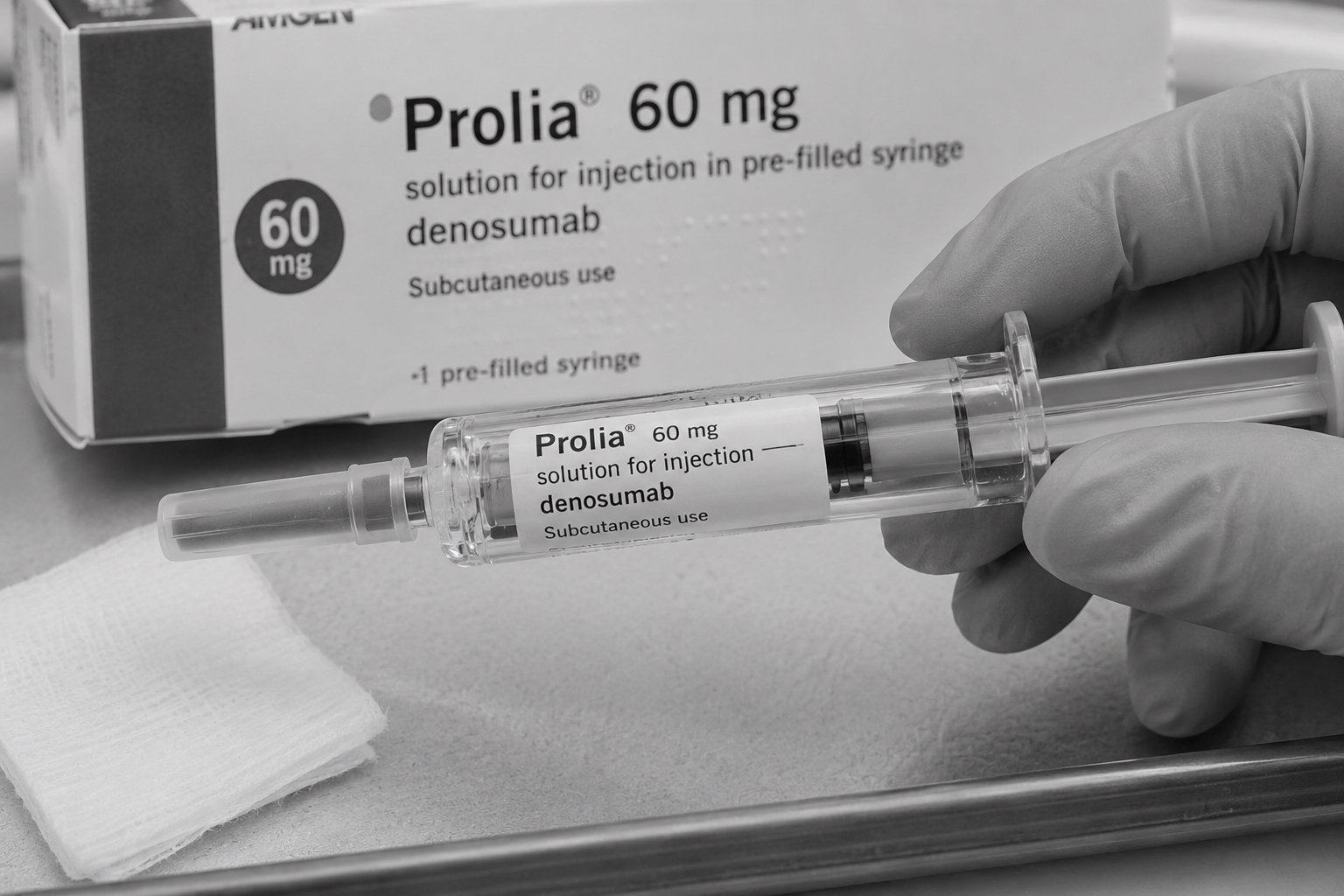
Denosumab, often known by the brand name Prolia, is one of the most important treatments used in osteoporosis care. It is also one of the treatments that needs the clearest long-term planning. Patients are often told that it is a “6-monthly injection for bones,” which is true, but it does not really explain where it fits in the overall treatment pathway, what monitoring is needed, what to do about dental treatment, what happens if an injection is delayed, or why it should never be stopped casually. That is where much of the confusion begins.
Where does denosumab fit in osteoporosis treatment?
Denosumab is an antiresorptive treatment, which means it slows the process by which bone is broken down. In practical terms, it is used to reduce fracture risk in people with osteoporosis. NICE recommends denosumab as an option for certain postmenopausal women at increased risk of fragility fracture, particularly when oral bisphosphonates are unsuitable because of intolerance, contraindication, or difficulty complying with the way those medicines need to be taken. In real-world NHS practice, local pathways also commonly use denosumab more broadly in adults with osteoporosis, including some men and patients in shared-care arrangements, depending on local protocols and fracture risk.
That means denosumab often comes into the picture when a patient:
cannot tolerate oral bisphosphonates,
is not a good candidate for them,
needs an alternative long-term antiresorptive treatment,
or is already in a higher-risk osteoporosis pathway where reliable fracture prevention is especially important.
How is denosumab given?
Denosumab is given as a 60 mg injection under the skin once every 6 months. It is usually administered in the upper arm, thigh or abdomen. Patients are normally advised to have enough calcium and vitamin D while on treatment, and many people take supplements alongside it. The practical attraction of denosumab is obvious: it avoids the weekly or monthly dosing routines of oral bisphosphonates and can be easier for some patients to stay on.
That convenience is real, but it comes with an important trade-off: denosumab needs to be given on time and with a plan. It is not the sort of treatment where missing a dose or stopping without follow-up can be taken lightly. That is one of the main reasons it deserves a dedicated blog rather than being treated as just another osteoporosis drug.
What do NICE and current guidelines say?
NICE’s technology appraisal supports denosumab in selected patients at increased fracture risk when oral bisphosphonates are unsuitable. More recent UK guidance from NOGG goes further in emphasising the practical management issues around denosumab, especially the fact that unplanned cessation should be avoided because it can lead to increased vertebral fracture risk. NOGG is very clear that denosumab must not be stopped without considering an alternative antiresorptive treatment.
That means denosumab should really be thought of as a treatment that requires a start plan, a continuation plan, and a stopping plan. Patients are often told the first part. They are not always told the second and third parts clearly enough.
What blood tests are needed?
Before starting denosumab, and usually before each 6-monthly injection, blood tests are needed to check that treatment is safe to give. In most UK protocols, this includes calcium, renal function, and often vitamin D. The Royal Osteoporosis Society says patients should usually have a blood test before each injection to check calcium, kidney function and sometimes vitamin D, and notes that some people will also need a blood test about two weeks afterwards, particularly if kidney function is reduced. Local NHS shared-care protocols are very similar, with some specifying that calcium, vitamin D and creatinine clearance should be checked around 4 weeks before each injection.
This matters because denosumab can cause hypocalcaemia — low calcium levels — especially if vitamin D is low or kidney function is impaired. So for patients, the practical message is simple: the injection is not just something that appears every six months in isolation. It sits within a monitoring pathway, and those blood tests are part of using it safely.
What about dental treatment and jaw health?
This is one of the commonest patient concerns, and understandably so. Denosumab, like bisphosphonates, carries a rare but recognised risk of osteonecrosis of the jaw (ONJ). That does not mean patients should panic or avoid treatment when it is otherwise appropriate. But it does mean dental health matters. The Royal Osteoporosis Society and NHS guidance emphasise good oral hygiene, regular dental care, and prompt reporting of oral symptoms such as pain, swelling, loose teeth or non-healing areas in the mouth.
A useful practical point is that a routine formal dental “clearance” is not automatically required for everyone before starting treatment. NOGG’s FAQ says a routine pre-treatment dental check is not necessary for all patients taking bisphosphonates or denosumab, but it is important that patients maintain good oral hygiene and get regular dental check-ups. If there are known dental problems, poor dentition, or likely invasive dental procedures coming up, it is sensible to address those early and to make sure your dentist knows you are on denosumab.
This links with Osteonecrosis of the Jaw (ONJ) and Osteoporosis Treatments: Bisphosphonates and Denosumab, which gives patients a more detailed explanation of that specific risk.
What are the main risks and side effects?
Most patients tolerate denosumab reasonably well, but like any treatment it comes with risks. Important ones include:
low calcium levels, especially in people with vitamin D deficiency or reduced kidney function,
commoner side effects such as musculoskeletal pain or skin problems,
and rare but important complications such as ONJ and atypical femoral fracture.
UK patient and NHS guidance also make a strong point about the risk of multiple vertebral fractures after stopping or delaying denosumab, which is the issue that most clearly distinguishes it from some other osteoporosis treatments.
That does not mean denosumab is a bad treatment. It means it is a treatment that needs to be used deliberately. In the right patient, it can be very effective. But it is not something to start casually without talking through what will happen later.
What happens if an injection is delayed?
This is one of the most important practical sections in the whole subject. Denosumab needs to be given roughly every 6 months, and significant delay is a problem because its effect wears off relatively quickly. The Royal Osteoporosis Society says it can usually be given up to about four weeks early or late if necessary, but beyond that the protective effect can wear off and rebound fracture risk may rise. Some NHS shared-care protocols say denosumab or alternative therapy should be given within four weeks of the due date.
So if a patient is going to be travelling, changing providers, moving house, or experiencing delays in blood tests or prescriptions, that needs active planning. A late denosumab injection is not just an administrative inconvenience. It can become clinically important.
How long should treatment continue?
Patients often ask, “How many years do I stay on this?” and the honest answer is that this depends on fracture risk, treatment response, comorbidities and the broader plan. Denosumab is not usually treated like a simple “course” with an assumed drug holiday at the end. NOGG states that routine cessation of antiresorptive therapy is not supported by current evidence, and denosumab in particular requires planned continuation or follow-on treatment rather than casual stopping. Some NHS pathways advise specialist review after a certain number of doses, but that review point is not the same as an automatic stop point.
That means patients should usually think in terms of ongoing review, not “I will have a few injections and then stop.” The right time to think about stopping is before you stop, not after a dose has been missed.
Why stopping denosumab needs a plan
This is the central message of the article. When denosumab is stopped, bone turnover can rebound quickly and some patients experience multiple vertebral fractures, sometimes within months of when the next dose would have been due. NOGG highlights this directly, citing increased risk of multiple vertebral fractures after discontinuation, and the Royal Osteoporosis Society makes the same warning in patient language.
So the correct approach is not simply “stop and see what happens.” In most cases, another osteoporosis treatment — often another antiresorptive — is needed when denosumab is discontinued. The exact choice and timing depend on the clinical situation, but the principle is clear in UK guidance: do not stop denosumab without arranging what comes next.
This is one reason denosumab is often a good treatment when the pathway is well organised, but a problematic one if the long-term plan is unclear. It is also why specialist input can be particularly valuable when deciding whether to start it in the first place, especially for patients who may later need treatment transitions, have complex fracture risk, or are uncertain how it compares with other options such as bisphosphonates or romosozumab.
The bottom line
Denosumab (Prolia) can be an effective and convenient osteoporosis treatment, especially for patients who cannot take oral bisphosphonates or where another antiresorptive pathway is more appropriate. It is given every six months, but it should not be thought of as “just an injection.” It needs blood-test monitoring, calcium and vitamin D optimisation, sensible attention to dental health, and above all a clear plan for continuation and eventual stopping.
The single most important practical message is this: denosumab is a treatment that must be started, timed and stopped properly. If that plan is clear, it can be an excellent option. If it is not, the risks of delay or abrupt stopping become much more important.
For some patients, especially where there is uncertainty about whether denosumab is the right treatment, concern about delays, questions about dental work, or the need to plan what happens when treatment stops, a specialist osteoporosis assessment can be helpful in clarifying the safest and most sensible long-term approach.
Related reading:
If you would like to explore related topics in more detail, you may find the following articles helpful:
Bisphosphonates for Osteoporosis: Benefits, Side Effects and How Long to Take Them
What Is a DEXA Scan — and How Is It Used in Assessing Bone Health?
Romosozumab (Evenity®) in Osteoporosis: When and Why It Is Used
Please note, these posts are for general information only and do not constitute medical advice. Dr Singh would encourage you to speak to your healthcare professional to be assessed and managed for your specific symptoms.