
Osteopenia, Osteoporosis and Fracture Risk: Why Your DEXA T-Score Is Not the Whole Story
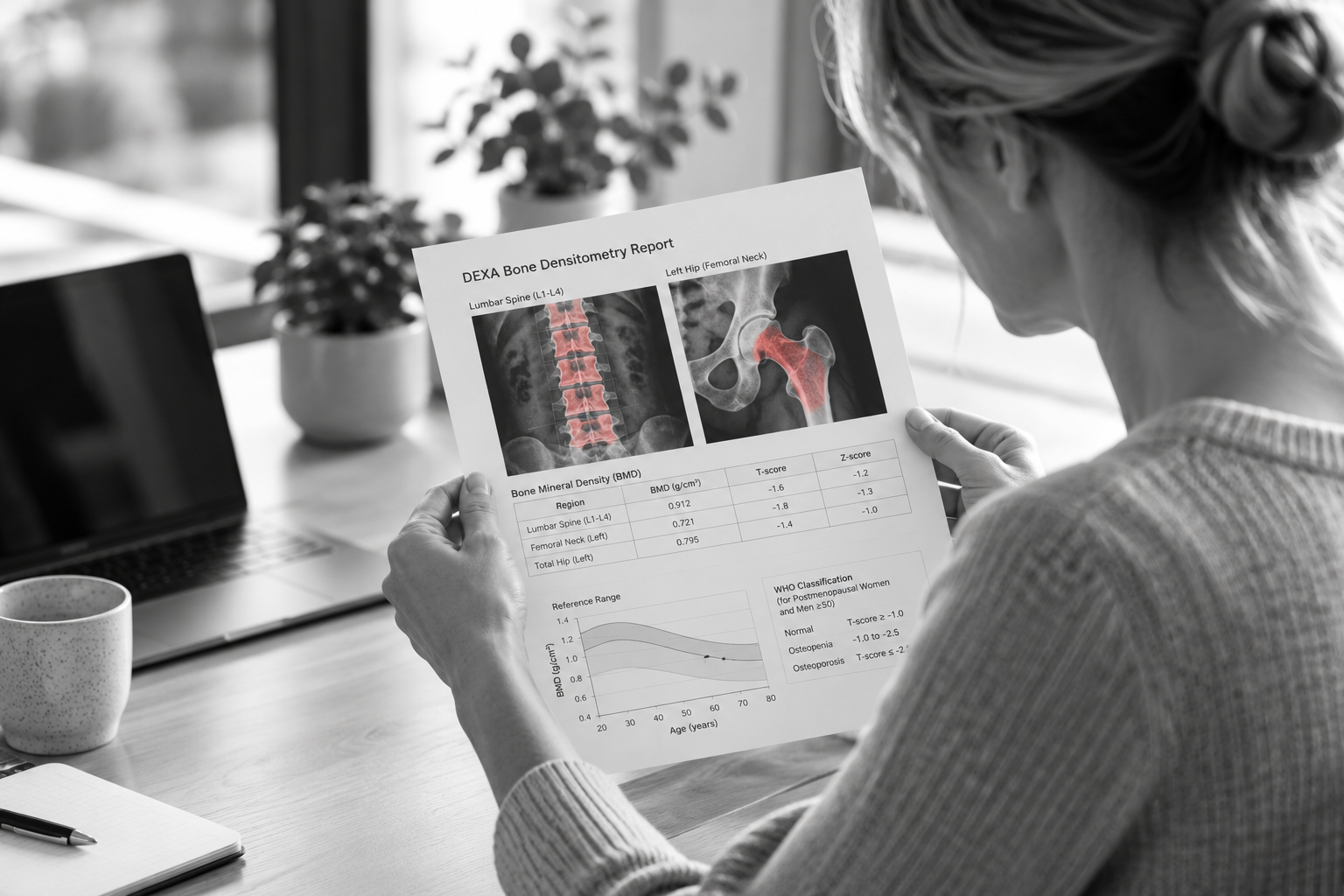
A DEXA scan is an important part of assessing bone health, but it is easy to place too much emphasis on the number printed on the report.
Patients often focus immediately on the T-score. A result of -1.5, -2.0 or -2.7 can sound as though it gives a complete answer about whether bones are “normal”, “weak” or at risk of fracture.
In reality, bone health is more nuanced.
A DEXA scan measures bone mineral density. It does not directly measure how likely someone is to sustain a fracture. Two people can have exactly the same T-score and yet have very different fracture risks because of their age, previous fractures, medications and wider health.
This distinction is particularly important in older adults being assessed for osteoporosis, but it is also increasingly relevant in younger people who have had a DEXA scan as part of a private health, menopause, fitness or “lifestyle” assessment.
What does a DEXA scan actually measure?
DEXA, or dual-energy X-ray absorptiometry, is the standard technique used to measure bone mineral density. The hip, femoral neck and lumbar spine are the sites most commonly assessed.
The report usually includes a T-score, a Z-score, or both.
A T-score compares bone density with that of a healthy young adult. In postmenopausal women and men aged 50 and over, a T-score above -1.0 is usually considered normal, a score between -1.0 and -2.5 is described as osteopenia or low bone mass, and a score of -2.5 or below meets the densitometric definition of osteoporosis.
These categories are useful, but they are not the same thing as an assessment of fracture risk. The International Society for Clinical Densitometry specifically distinguishes between diagnostic classification and fracture-risk assessment, and notes that people with low bone mass are not necessarily at high risk of fracture.
Osteopenia does not automatically mean treatment is needed
The word osteopenia can cause understandable concern.
Someone may be told that their bone density is “below normal” and assume this means that osteoporosis is inevitable or that medication should be started immediately.
Neither conclusion necessarily follows.
Osteopenia simply means that bone mineral density falls within a particular numerical range. What matters clinically is how that result fits with the person’s overall fracture risk.
A healthy 55-year-old with a T-score of -1.8, no previous fractures and no major risk factors may have a relatively low probability of fracture.
A 78-year-old with the same T-score who has already sustained a wrist fracture after a simple fall, has rheumatoid arthritis and has required repeated courses of prednisolone is in a very different position.
The scan result may be similar. bu the clinical risk is not.
Fracture risk matters more than the T-score in isolation
The purpose of osteoporosis assessment is not simply to identify people whose T-score crosses a numerical threshold.
The aim is to prevent fractures.
For this reason, UK guidance recommends assessing absolute fracture risk, taking account of factors beyond bone density. NICE recommends use of tools such as FRAX or QFracture to estimate 10-year fracture probability in appropriate patients, while NOGG uses FRAX to stratify people into low, intermediate, high and very-high fracture-risk categories.
Age is important. Previous fragility fracture is important. So are steroid exposure, smoking, alcohol intake, low body weight, family history, rheumatoid arthritis and other medical conditions that affect bone.
Falls also matter clinically, even though no risk calculator captures every aspect of an individual’s fracture risk perfectly.
This is why a DEXA result should be treated as one part of the assessment rather than the final answer.
Why a previous fracture changes the picture
A previous fragility fracture is one of the strongest indicators that future fracture risk may be increased.
A fragility fracture usually refers to a fracture occurring after relatively minor trauma, such as a fall from standing height.
It tells us something that bone density alone cannot: the skeleton has already failed under relatively modest stress.
Vertebral fractures are particularly important because they are not always dramatic. Some are discovered after height loss, increasing spinal curvature or imaging performed for another reason.
NOGG recommends considering treatment particularly in older people who have sustained a prior or recent fragility fracture, with fracture-risk assessment helping to guide the choice of treatment.
This is also why someone can merit osteoporosis treatment even when their T-score is not below -2.5.
What is FRAX and why is it useful?
FRAX is a fracture-risk assessment tool that estimates the 10-year probability of a major osteoporotic fracture and of hip fracture.
It considers clinical factors such as age, previous fracture, parental hip fracture, smoking, glucocorticoid exposure and rheumatoid arthritis. Femoral-neck bone density can also be incorporated when available.
This makes FRAX conceptually different from a DEXA scan.
DEXA tells us about bone density.
FRAX helps place that information into a broader estimate of fracture probability.
Like any risk calculator, FRAX has limitations. It does not perfectly capture factors such as fracture recency, multiple fractures, falls or the precise dose of glucocorticoid treatment. Clinical judgement therefore remains important.
Steroid treatment is a good example of why context matters
Glucocorticoids such as prednisolone can increase fracture risk.
The effect is not completely explained by the bone density measured on a DEXA scan. Someone taking significant or prolonged steroid treatment may therefore have a higher fracture risk than their T-score alone would suggest.
This is particularly relevant in rheumatology, where conditions such as polymyalgia rheumatica, vasculitis and inflammatory arthritis may require glucocorticoid treatment.
Bone-health assessment in these circumstances should therefore take account of the underlying disease, steroid dose and duration, age, previous fractures and other risk factors rather than simply applying a numerical DEXA threshold.
Why the hip and spine scores may not match
Patients often notice that the T-score at the hip is different from the score at the lumbar spine.
This is common and does not mean that one result is necessarily incorrect.
Bone density is not identical throughout the skeleton, and several factors can affect measurements at individual sites.
For example, degenerative change in the lumbar spine can sometimes artificially increase the measured spinal bone density, particularly in older adults. In other people, lumbar spine density may genuinely be substantially lower than hip density.
Marked discordance between sites can sometimes influence interpretation of fracture risk.
The important point is that the entire DEXA report should be considered rather than simply selecting one number in isolation.
What about younger people having “lifestyle” DEXA scans?
This is becoming increasingly relevant.
People in their 30s, 40s and early 50s may now undergo DEXA scanning through executive health assessments, private screening programmes, menopause clinics, gyms, sports clinics or broader wellness packages.
The scan may then generate a T-score and the person may be told they have “osteopenia”.
That terminology can be misleading in younger people.
In premenopausal women and men under the age of 50, Z-scores are generally preferred to T-scores. A Z-score compares bone density with other people of a similar age and sex.
A Z-score above -2.0 is described as within the expected range for age, while a score of -2.0 or below is described as below the expected range for age.
So, for example, a Z-score of -1.8 is technically still within the expected range for age, even though it lies towards the lower end of that range.
This is very different from simply taking the T-score and applying the postmenopausal osteoporosis categories to a healthy 35- or 40-year-old.
Low bone density in a younger person needs interpretation rather than a label
A younger person can have relatively low bone density without having osteoporosis.
In this age group, the more useful question is often: Why is the bone density lower than expected for this particular person?
Some people may simply have constitutionally lower bone density.
In others, an underlying factor may be contributing. Examples include low body weight, nutritional deficiency, coeliac disease, premature ovarian insufficiency, low sex hormone levels, thyroid or parathyroid disease, chronic inflammatory conditions, long-term glucocorticoid treatment and certain other medications.
The clinical context therefore matters considerably and this is one reason indiscriminate DEXA screening in healthy younger people can sometimes create more uncertainty than useful information.
Stress fractures are another example of why DEXA is only part of the story
Stress fractures are different from the typical fragility fractures associated with osteoporosis, but they illustrate the same underlying principle.
A young runner or athlete may develop a bone stress injury despite having bone density that is not frankly abnormal.
Training load, recovery, energy availability, nutrition, menstrual or hormonal health and other factors all affect the ability of bone to adapt to repeated loading.
One straightforward stress fracture after a substantial increase in training does not necessarily imply a bone disorder. Recurrent stress fractures, multiple sites or injuries that appear disproportionate to the level of activity may justify a broader assessment of bone health.
In those circumstances, a DEXA scan may contribute useful information, but it still needs to be interpreted alongside the wider clinical picture.
This is explored in more detail in Stress Fractures in Young People: When Should You Look More Closely at Bone Health?
Does a T-score of -2.5 automatically mean medication is required?
A T-score of -2.5 or below meets the densitometric definition of osteoporosis in the groups for whom that classification applies.
It does not mean that every patient should be managed identically.
Treatment decisions still take account of age, previous fractures, overall fracture probability, falls, secondary causes of osteoporosis, other medical conditions and patient preference.
The reverse is equally important and someone whose T-score is above -2.5 may still have sufficiently high fracture risk to benefit from treatment.
This is why modern osteoporosis management is based on overall fracture probability and clinical context rather than a single number.
When does a DEXA result deserve a closer look?
Some results are straightforward. Others need more careful interpretation.
Further assessment can be particularly useful when there has already been a fragility fracture, when fractures are recurrent, when bone density appears unexpectedly low for age, or when the scan does not seem to fit the clinical picture.
The same applies when there is significant glucocorticoid exposure, an underlying condition that may affect bone, or uncertainty about whether treatment is necessary.
More specialist input can also be helpful when treatment decisions become complex, for example in people with very high fracture risk, multiple vertebral fractures, intolerance of standard therapy, or where anabolic treatment or more complicated treatment sequencing is being considered.
The purpose of specialist assessment is not simply to prescribe an osteoporosis drug. It is to understand what the scan means for that particular person, determine whether there is an underlying cause that needs addressing, and decide whether treatment is likely to reduce meaningful fracture risk.
Sometimes the appropriate outcome is medication.
Sometimes it is further investigation.
And sometimes it is reassurance.
The key message
A DEXA scan is an important tool in assessing bone health, but the result should never be viewed in isolation.
A T-score tells us about bone mineral density.
It does not tell us everything about the likelihood of fracture.
For an older adult, age, previous fractures, steroid exposure, falls and other medical conditions may substantially alter the significance of the scan.
For a younger person having a private or “lifestyle” DEXA, the opposite problem can occur: a mildly low T-score may sound worrying even though applying an osteoporosis label may be inappropriate and the age-matched Z-score may still fall within the expected range.
The most useful question is therefore not simply:
“What is my T-score?”
It is:
“What does this result mean for my overall bone health and fracture risk?”
That is the question that should guide whether reassurance, further investigation or treatment is appropriate.
Dr Animesh Singh, Consultant Rheumatologist. GMC: 6130215
Related Articles
DEXA Scan Explained: What Your Bone Density Results Mean
Stress Fractures in Young People: When Should You Look More Closely at Bone Health?
Bisphosphonates: Benefits, Risks and How Long Should You Take Them?
Denosumab (Prolia): Why You Need a Plan Before Stopping
Osteonecrosis of the Jaw: Bisphosphonates, Denosumab and the Real Risk
Related Condition Pages
Please note, these posts are for general information only and do not constitute medical advice. Dr Singh would encourage you to speak to your healthcare professional to be assessed and managed for your specific symptoms.